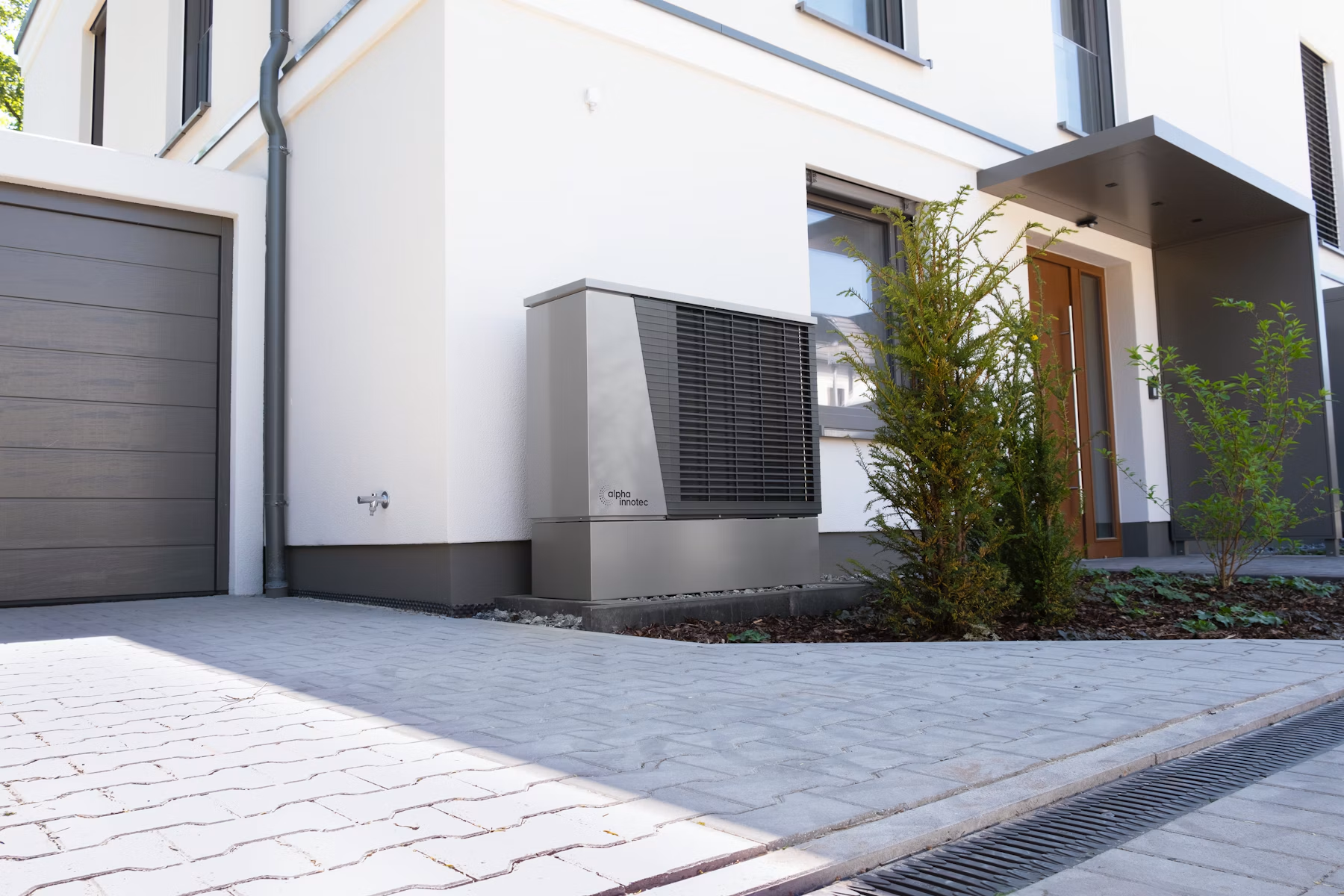
I’ve been circling heat pumps for a while.
Not literally. We haven’t got one sitting in the garden.
But once you start trying to make an old house warmer without simply turning the boiler up, you eventually arrive at the same question:
Could this house actually run on a heat pump?
Ours is a fairly ordinary 1930s semi. It wasn’t designed with low-temperature heating in mind. It has suspended floors, bits that leak air, radiators installed at various points in its life and the usual collection of small mysteries that you inherit with an older house.
We’ve already tackled some of the obvious stuff.
The front door gap no longer refrigerates the hallway. I’ve spent more time than I care to admit chasing draughts through the suspended floor. The radiators are behaving better.
So I decided to work out what would actually be involved in replacing the gas boiler with an air-source heat pump.
Not what the brochure says.
What would have to change in this house.
The first surprise: the heat pump wasn’t really the starting point
I assumed the big question would be:
What size heat pump do we need?
It isn’t.
The useful question is:
How much heat does the house lose when it’s properly cold outside?
That sounds like much the same thing, but it changes how you look at the whole job.
A boiler can hide quite a lot of sins.
If the house loses heat quickly, you can compensate by sending very hot water through the radiators. The boiler fires hard, the radiators get roasting hot and the room eventually warms up.
A heat pump prefers not to work like that.
The lower the water temperature it can use while still keeping the house comfortable, the better.
Suddenly all those boring little jobs I’d already been doing started to make more sense.
Stopping draughts wasn’t just about making the sofa less chilly.
It was reducing the amount of heat the heating system needs to replace.
So I started looking at the radiators
This was the bit I’d underestimated.
The question isn’t simply whether our existing radiators work. They obviously do.
It’s whether they can put enough heat into each room when the water running through them is cooler.
That is a different test.
A radiator that is perfectly adequate with hot boiler water may be rather less impressive when you ask it to heat the same room at a much lower flow temperature.
This also made the time spent balancing the system feel slightly less obsessive.
We’d already found that radiator performance can come down to surprisingly small things. One radiator that appeared to be a problem was eventually transformed by what amounted to the last couple of turns on the valve.
That matters because I don’t want to replace a house full of radiators just because somebody’s quote says “heat pump upgrade”.
I want to know which ones actually need changing.
Would we need bigger radiators everywhere?
Probably not.
That was another useful lesson.
Before looking into this properly, I had a vague mental picture of a heat-pump installation involving enormous new radiators appearing in every room.
The reality is more nuanced.
Some rooms may already have enough radiator capacity. Some may need a larger double-panel radiator. A room with particularly high heat loss might need more substantial changes.
But you can’t sensibly answer that until you know two things:
- how much heat each room loses;
- how much heat its radiator can deliver at the intended water temperature.
That is the calculation I’d want to see in a proper quotation.
Not:
“Three-bed semi: 8kW heat pump.”
Our three-bed semi is not necessarily losing the same amount of heat as the identical-looking three-bed semi next door.
Insulation changes the heating system
This is the bit that seems obvious once you see it written down.
Every bit of heat we stop losing is heat the heating system no longer has to produce.
The suspended floor draught hunt is a good example.
At the time, I was trying to solve the very scientific problem of my feet being cold.
But if cold outside air is constantly finding its way into the room, the heating system has to warm that replacement air.
Stop some of the air leakage and the heating demand falls.
The same applies to the front door.
Our £20 door fix obviously isn’t going to turn the house into Passivhaus.
But lots of small improvements start changing the calculation.
That is why I’m increasingly convinced we’ve done this in the right order.
House first. Heating system second.
Then there’s the hot-water problem
Radiators are only half the story.
Our boiler also produces hot water.
A heat pump can do that too, but it usually means having a hot-water cylinder somewhere.
And “somewhere” is doing quite a lot of work in that sentence.
Old houses contain cupboards, chimney breasts, pipes and various spaces that look enormous until someone suggests putting a cylinder in them.
So any quote for us would have to answer a very mundane question:
Where is everything actually going?
Outdoor unit.
Cylinder.
Pipework.
Controls.
Any radiator changes.
Possibly a buffer or other components depending on the design.
I’m not interested in a theoretical heat pump that works beautifully provided we sacrifice half the house to plumbing.
What about the outdoor unit?
This was less alarming than I expected.
We have possible locations for one.
But position matters.
There’s airflow to consider, pipe runs, neighbours, servicing access and the fact that I don’t particularly want to spend the next decade staring at a large fan every time I make a cup of tea.
Noise is another thing I’d want demonstrated rather than described.
“Quiet” is one of those words that means absolutely nothing without a number and some context.
Quiet compared with what?
A fridge?
A boiler?
A 747?
If we get as far as choosing a unit, I’ll be looking at its actual rated sound output and where that leaves us at the nearest window and boundary.
The electricity rabbit hole
This is where I lost an evening.
Replacing gas heating with a heat pump obviously means buying more electricity.
The heat pump should produce several units of heat for each unit of electricity it consumes, but the economics still depend on the house, system efficiency, electricity tariff and how we actually use the heating.
Then I started thinking about solar.
If we electrified more of the house, could producing some of our own electricity improve the numbers?
Maybe.
But there’s an annoying mismatch with domestic solar: you don’t necessarily consume the most electricity when the panels are producing the most.
That sent me down another rabbit hole looking at how the calculation changes for businesses.
A factory, warehouse or other business that uses lots of electricity through the working day can potentially consume solar generation while it is actually being produced. I found this overview of commercial solar in Spain interesting because it approaches the problem from that larger-scale consumption angle.
Different country, very different buildings, same underlying lesson:
Generation only makes sense when you understand consumption.
I’ve now added our electricity usage profile to the growing list of things I want to understand before spending serious money.
Would solar make our heat pump free to run?
No.
Or at least that isn’t how I’d calculate it.
That claim always feels a little too convenient in the UK because the periods when we need the most heating are also the periods when solar generation is relatively poor.
Solar could certainly contribute.
A battery could change when some of that electricity is used.
A time-of-use tariff might change the calculation again.
But I’m not going to add together the annual output of some solar panels and the annual consumption of a heat pump and declare victory.
January still exists.
What I’d want from an installer
After looking into this, I’m much clearer about what I would want before signing anything.
Not a salesman pointing at the existing boiler and telling me which heat pump replaces it.
I’d want:
- a proper room-by-room heat-loss calculation;
- proposed design and flow temperatures;
- output calculations for the existing radiators at those temperatures;
- a clear list of which radiators genuinely need changing;
- expected seasonal efficiency;
- annual electricity consumption assumptions;
- hot-water cylinder requirements;
- outdoor-unit location and noise figures;
- the complete installed cost;
- and an explanation of anything we could sensibly improve before sizing the system.
If changing one radiator and fixing another draught means installing a smaller system, I want to know that.
The number I’m not going to invent
I could finish this post with a big figure.
“Our heat-pump conversion will cost £X.”
But I don’t have a sufficiently detailed quote yet, and making up a number would rather defeat the point of this site.
There are too many variables.
The heat pump itself is only part of the job. Radiators, cylinder, electrical work, pipework and the condition of the house all matter.
Government support can change the amount the homeowner actually pays as well.
So I’ll put the real figure here when I have one I trust.
More importantly, I’ll put the specification next to it.
A £7,000 quote and a £12,000 quote tell you very little if they’re quoting for two completely different systems.
So, is our 1930s semi ready for a heat pump?
I think the answer is:
Possibly, but I want the house ready before I buy the machine.
That is quite different from where I started.
I assumed investigating a heat pump would mainly involve comparing heat-pump brands.
Instead, it has sent me back around the house looking at heat loss, radiator sizes, draughts, hot-water storage and electricity consumption.
Which is probably a good thing.
The more heat we can keep inside the house, the easier it becomes to heat it with anything.
And even if we eventually decide not to install a heat pump, none of the work we’ve already done is wasted.
The house is still warmer.
The draughts are still smaller.
And my feet are considerably less annoyed.